Quod Erat Demonstrandum (Q.E.D.)
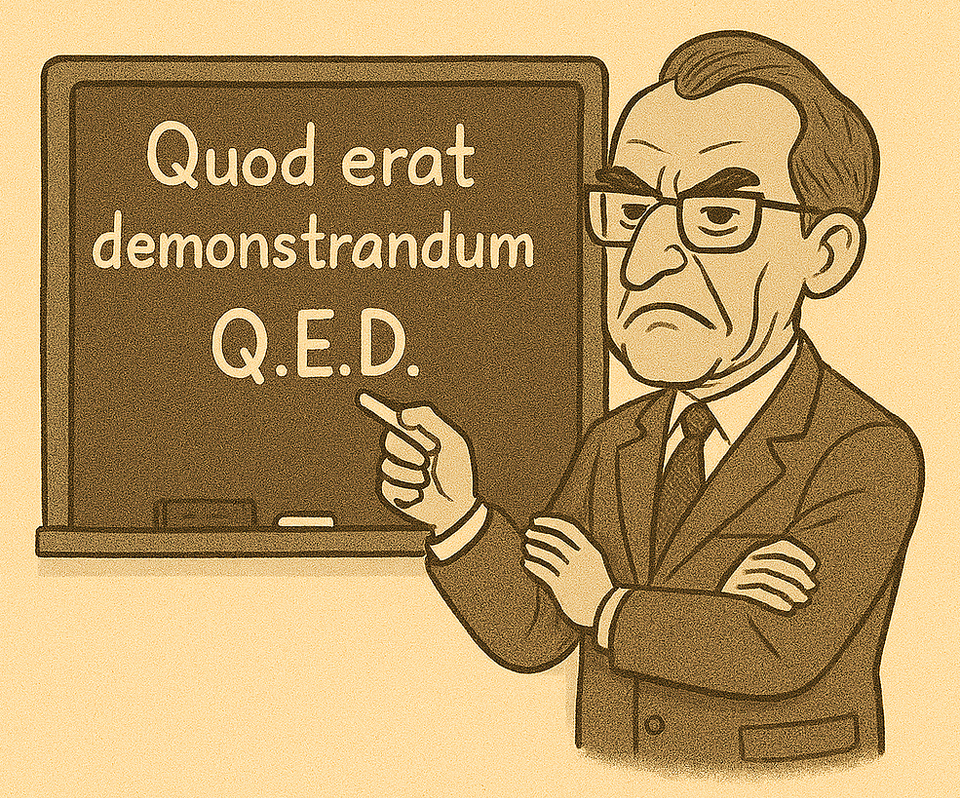
A Brief Defense of One of Western Thought’s Most Elegant Full Stops
Quod erat demonstrandum, commonly abbreviated Q.E.D., is a Latin expression meaning:
“That which was to be demonstrated.”
Despite its brevity, Q.E.D. occupies a place of remarkable importance in the intellectual history of mathematics, philosophy, logic, and scholarly writing more broadly. It is not merely a phrase; it is a structural signal, a rhetorical seal, and a declaration of epistemic closure.
Origins and Function
Q.E.D. originates in the tradition of classical Greek mathematics, notably in the works of Euclid, whose Elements provided systematic proofs of geometric propositions. Euclid himself wrote in Greek, using the phrase hóper édei deixai—“which was to be shown.” Medieval scholars later translated this into Latin as quod erat demonstrandum, and from there it entered the standard vocabulary of formal proof.
The role of Q.E.D. is neither ornamental nor dramatic. Quite the opposite. It appears only after all necessary reasoning has been completed, when no further argument is required and no appeal to authority, emotion, or intuition remains.
Its job is simply to say:
“The chain of reasoning is complete.
The claim has been fulfilled.
Nothing further is necessary.”
Why Q.E.D. Matters
1. It Signals Logical Sufficiency
When Q.E.D. appears, it asserts that the original proposition has been proven exactly as stated, using only the permitted assumptions and steps. There is no excess and no omission. The proof has neither overreached nor underdelivered.
In that sense, Q.E.D. is not boastful. It does not say “this is brilliant.” It says, far more modestly and far more powerfully:
“This is enough.”
2. It Respects the Reader
Q.E.D. implies trust in the reader’s rational faculties. It does not recap, persuade, or summarize emotionally. It simply draws a line and leaves the reader to verify, reflect, or dispute within the same logical frame.
It is a scholar’s way of saying:
“You have the same tools I used.
Check it if you wish.”
This confidence—quiet, restrained, and precise—is one reason the phrase has endured for centuries.
3. It Marks the End of Legitimate Debate
Once Q.E.D. has been properly earned, continuing to argue is no longer a matter of reason—it becomes a matter of preference, misunderstanding, or denial.
The phrase thus serves as an epistemic door‑closer. Not authoritarian, but definitive. Debate may continue elsewhere, but this question, on these terms, has been resolved.
Q.E.D. Beyond Mathematics
Over time, Q.E.D. migrated beyond geometry into:
- Philosophy
- Formal logic
- Legal reasoning
- Scholastic theology
- Even dry academic humor
Wherever structured reasoning culminates in an inevitable conclusion, Q.E.D. offers a compact way of acknowledging completion without flourish.
It is the intellectual equivalent of setting the pen down.
And Now, the Necessary Degeneration into Plain English
Having said all that—having honored the precision, dignity, and historical grandeur of Quod erat demonstrandum—we arrive at an unavoidable and deeply amusing realization.
In everyday English, stripped of Latin gravity and academic robes, the closest functional equivalent of this magnificent device is simply:
“Bob’s your uncle.”
Both mean:
- The steps are complete.
- The outcome follows naturally.
- No further explanation is required.
- The result is inevitable given the setup.
Where Q.E.D. says this with austere confidence,
“Bob’s your uncle” says it with cheerful inevitability.
Same logical structure.
Different dinner table.
And with that…
Q.E.D.
(Bob’s your uncle.)