A Modestly Heroic Account of a Day That Refused to Be Simple
The day began, as many overly confident days do, with a sense of calm that in retrospect now feels rude.
There was coffee. There were plans. Somewhere in the background, there was even a Facebook post forming—something reflective, spiritual, and tidy. It would later become clear that the universe had other plans and found tidy ideas suspicious.
Before leaving the house, I did a thing I almost never do: I put my security badge somewhere reasonable. This was a bold experiment. Unfortunately, reasonable places are the least reliable places of all. Minutes later, I was driving toward a datacenter with confidence, momentum, and—critically—no security badge.
I decided not to turn around. This decision would prove philosophically interesting.
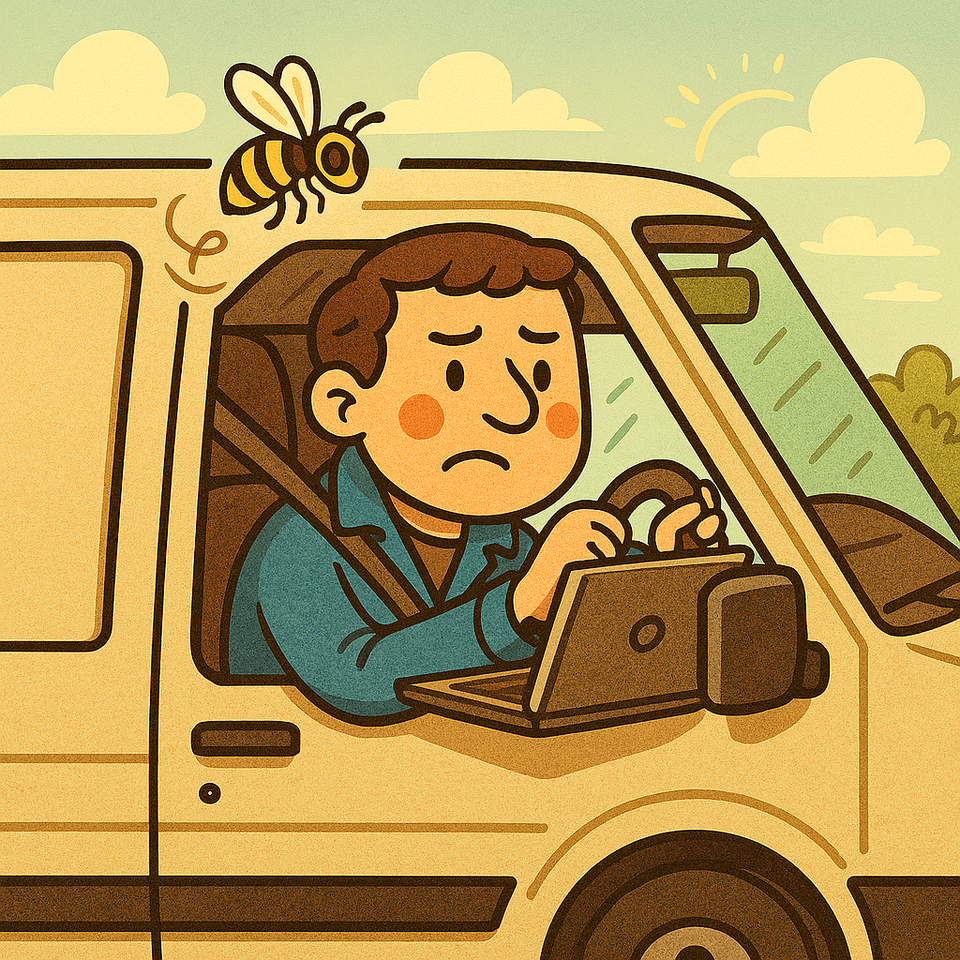
As I exited the expressway, a wasp entered the narrative.
Not metaphorically. Literally.
It flew into the cab of the van and landed inches from my face, staking out the sun visor as if it had an appointment. I froze, calculating the odds of survival versus humiliation. Past wasp experiences involving burning sensations reminiscent of habanero juice applied directly to the eyes were weighed carefully. The wasp, mercifully uninterested in escalation, remained still. We reached a tentative détente.
I arrived at the datacenter.
Without a badge.
This is where the day introduced its first motif: systems work until they don’t, and then humans must negotiate gently with reality.
I made it into the building. I made it into the war room. And there, with exquisite timing, I realized I did not know the customer password because I had been hacked recently and had not yet committed the new one to memory.
At this point, I was both physically and logically disabled.
I existed in a strange liminal state:
- unable to move freely,
- unable to log in,
- present without function.
Other engineers were polite, helpful, and absolutely unwilling to babysit a badge‑less technician for an entire day, which was both reasonable and enlightening.
The correct conclusion emerged: retreat.
As I was escorted out—an experience that always adds an unnecessary air of drama—a second customer called. Their firewall was completely down. No ambiguity. No blinking lights of hope. Just absence.
I returned home with a plan forming that had roughly the structure of competence and the emotional flavor of acceptance.
Lunch happened. Cold kielbasa, Polish rye, “monster” cheese, mayo, and small gołąbki. There was no spicy spice spice spice. This would be deferred for safety and strategy.
Micro Center appeared like a pilgrimage site.
The staff were busy but kind, and one associate opened the box before checkout to confirm the hardware was acceptable—a human moment in a day filled with machines. The price was approved. No markup. I absorbed the tax. Everyone remained calm. Rufus.exe copied firmware in the background like a loyal squire.
Back home, the installer refused to see the 2.5 Gb interfaces.
This was not stressful, surprisingly, because for once the problem was behaving typically. Drivers. Realtek. FreeBSD. Ancient knowledge reactivated. The solution involved Android USB tethering, which at first appeared impossible because Android, like a cat, does not allow tethering unless it senses respect.
USB tethering was greyed out. Then re‑enabled. Then lost on reboot. Then re‑enabled again. This cycle repeated until it stopped being irritating and instead became instructive.
Eventually, the Realtek drivers were installed. The firewall booted. Config was restored. The device was boxed. On‑site deployment took 25 minutes, including socialization, because systems are faster when relationships are maintained over time.
The VPN did not come up.
The far‑side firewall was running firmware from 2019.
This explained everything.
Upgrading that firewall turned out to be iterative, which is the polite term for climbing a staircase while wearing a backpack full of reboots. After hours of progress that only reached 2021, a decision was made that felt prudent, calm, and mildly radical:
We would stop trying to bring the past forward and instead choose a protocol that lived comfortably in the present.
IPsec.
And just like that—boom—Phase 1 established. Phase 2 installed. Traffic flowed. Bytes increased. The system, satisfied, grew quiet.
I called the customer. I explained it was done. I could see traffic. I mentioned I had availability tomorrow if needed. They were pleased.
And the strangest part of the day emerged clearly at the very end:
I was barely stressed.
Not during the NIC issue. Not during USB tethering chaos. Not while juggling firewalls spanning seven years of software evolution.
The reason, I think, is recursive:
At several points, when the day could have become a story about panic, it instead became a story about problem‑solving. Each solved problem quietly rewrote the tone of the chapter that followed.
Which brings us here—writing about the day, inside the day’s afterglow, knowing full well that if I had written this essay this morning, it would have been wrong.
Because the meaning of a field engineer’s day is not known at the beginning.
It is discovered at the end.
And sometimes the best ending is not triumph, but this:
Everything works.
No one is upset.
Dinner is waiting.
And tomorrow, if something breaks, I’ll be around.
Which, all things considered, is a pretty good feature—not a bug. ❤️